
'As long as Amul was coming in with products it was not a problem because it was something value added and with a shelf life.' 'When it gets into the local market by procuring locally, it cuts into the market-share of local cooperatives.'

States have been told to prepare in advance to counter any impact of an adverse southwest monsoon.

In a significant development, India is believed to have placed a funding request of around $55 million in its first call with the Pandemic Fund of the World Bank, sources said. The fund has been set up to finance critical investments in a bid to strengthen pandemic prevention, preparedness, and response capacities at national, regional, and global levels, with a focus on low- and middle-income countries. It was created in the aftermath of the Covid-19 global pandemic.

With different agencies showing divergent predictions regarding the southwest monsoon, the central government and states are gearing up to face adversity with various line ministries reportedly being directed to undertake mock drills and hold preparatory meetings. Around 56 per cent of the net cultivable area of the country is rain-fed, accounting for 44 per cent of foodgrain production. The June-September rains contribute around 73 per cent of the annual precipitation.

'For our traditional membership base, it would be an access to disruptive ideas,' FICCI President Subhrakant Panda tells Asit Mishra/Business Standard.
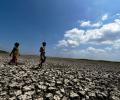
The onset of the southwest monsoon is being keenly watched this year as it may provide an early sign regarding its progress over the Indian subcontinent, particularly when El Nio is expected to rear its head during the latter half of the season.

While some states have kicked in their heat action plans, experts feel this is not enough to tackle the current extreme weather.

India's overall imports from Taiwan during April-February rose by 34 per cent to $7.5 billion.

The Centre has issued an advisory to states to speed up the preventive vaccination process.
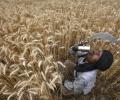
There has not been a large impact of untimely rain and hailstorm so far in several major wheat-growing areas, and those might have damaged around 3 per cent of the standing crop -- not enough to make a big dent in the expected 112 million tonnes of production in FY24, a senior government official said on Tuesday. Relentless rain pounded most North Indian states all through March. Separately, the chairman of Food Corporation of India (FCI), Ashok K Meena, told reporters the agency was on track to achieve the targeted 34 million tonnes of procurement in FY24 on the back of a strong start to the purchase season from Madhya Pradesh.

Due to the huge pile-up of visa applications, the US consular officers in the neighbouring country are now adjudicating Indian visa applications where interview requirements have been waived.

Prime Minister Modi last week called for optimal grain storage, fire audits and mock drills in hospitals as preparations for the harsh summer forecast by the meteorological department.

The government may be staring at a modest slippage in fiscal deficit for 2022-23 (FY23), with the Ministry of Finance seeking parliamentary approval for additional spending through a second and final tranche of supplementary demands for grants. On Monday, as the Budget session of Parliament resumed, Finance Minister Nirmala Sitharaman sought Parliament approval for additional gross spending of Rs 2.7 trillion in FY23 (which ends on March 31). While net cash outgo is pegged at Rs 1.48 trillion, the rest will be matched by savings or enhanced receipts, the finance ministry said.

India is the UK's second-largest market by volumes for Scotch, importing the equivalent of 136 million bottles, worth £146.2 million, in 2021.

The Gross Value Added (GVA) in agriculture and allied activities is projected to clock its best growth in FY23 during the October-to-December quarter, at 3.7 per cent, on the back of a strong kharif harvest, according to the second advance estimates of national income. In the third quarter of FY22, GVA in the sector was 2.3 per cent at constant prices. At current prices, the growth in the third quarter of this financial year is projected at 8.6 per cent, which is almost at the same level in the corresponding quarter of FY22.

In the coming few weeks, agriculture markets in North and Central India will be full of wheat, mustard, and chana - the three main rabi crops grown in these parts. Not only will the price trajectory of these determine the course of food inflation in the months to come, but it could also have a wider impact on the rural economy in the main growing states for these crops. Wheat and chana are largely grown in Madhya Pradesh (MP).

India has put curbs on wheat exports through the government route, starting November last year. This comes amid a surge in domestic prices of the cereal. In December, India exported 391 tonnes of wheat to Bangladesh and Bhutan. In November 2022, it had exported 375 tonnes of wheat only to Bhutan.

The finance ministry on Thursday raised concerns over the possible impact of El Nio conditions on India this year, saying if recent forecasts came true, the country could see lower agricultural output and higher inflation. "Some meteorological agencies predict the return of El Nio conditions in India this year. "If these predictions are accurate, then monsoon rains could be deficient, leading to lower agricultural output and higher prices," the ministry said in its monthly economic review.
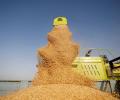
Temperatures in March will be critical to determining the impact of any unusual heatwave conditions on this year's wheat crop in North India. It is that time of the year when the crop enters its vital grain-filling stage, say meteorologists and crop experts. So far, the high day temperatures in the North are not believed to have any significant impact on the final yields since the crop hasn't entered a stage where heat affects yields.

India has substantially increased its crude oil imports from the US, with the country's share in India's crude basket hitting a record 14.3 per cent in December, commerce ministry data showed.
 © 2025 Rediff.com - Investor Information - Advertise with us - Disclaimer - Privacy Policy - Sitemap - Feedback - About us - Terms of use - Grievances